
We've moved! Find us at 238 Bridge st, Northampton
Laura Radwell: Embodied Landscape
Oct 14, 2019
November 6th – 30th, 2019
Paintings by Northampton artist Laura Radwell, November 6th – 30th
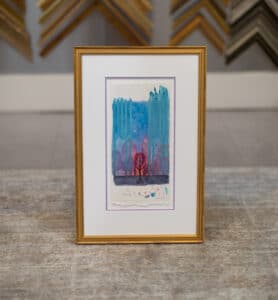
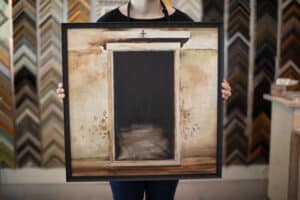
Laura Radwell’s work is characterized by atmospheric and dream-like components of landscape that drift, overlap, and morph into one another. These new works are an exploration of a further point along that continuum involving tighter, more disciplined, and dynamic compositions — they emerge from a place she has not been before, a willingness to commit to more definition. Geometry, line, and shape that she sees as muscular and lyrical, reflect the natural landscape, but they often go beyond to evoke the sinuous forms and contours of the human body. She sees the work as a melding of gesture and body contained in landscape and landscape contained in the body.
Opening Reception: Thursday, November 7th, 5-8pm, during Amherst Arts Night Plus.
Please note: the shop is closed for Thanksgiving Nov 28th & 29th, so the exhibit has been extended to Saturday Nov 30th.
About Laura Radwell:
Laura is an artist, designer, and devoted collector of visual impressions who has lived in Northampton since 1974. She began to paint in the late 1980s, and over the years has continued to explore various media: traditional oil painting, sculpture, calligraphy, and photography. In 2014, she returned to painting with oils with an expressive approach — looser, more personal studies in color, texture, and form. Though abstract, the work retains central aesthetic aspects of landscape, conveying feelings and emotions that range from peace and acceptance to turmoil and yearning. Learn more about Laura at: lauraradwell.com
Q&A with Laura
How old were you when you created your first artwork?
I think I was about 12 years old when I did an oil painting of a small candlestick holder that was a favorite household object. My granddaughter saw it and recently asked me to give it to her to hang by her bedside.
When did you know you wanted to be an artist?
As a young child I loved to draw and paint, but was steered toward other academic pursuits by my parents. I do recall thinking about art school, but at that time my vision was not fully-formed, and I followed a different path. After college, it became apparent that what was missing in my life was visual expression, and the work that I did over ensuing decades started to incorporate visual components. In essence I was working with color, shape, and form and realizing that my dream was to be a (fine) artist someday.
Why did you choose your medium?
Early on I painted with watercolors, but didn’t find them satisfying. I yearned for more and deeper color. After forays into other art practices including calligraphy, batik, sculpture, and, more recently, digital (photographic) abstractions and mixed media, painting with oils was like coming home.
What inspires you?
Two things: nature and emotions. Nature is a never-ending source of inspiration, every day the light changes, the landscape shifts, the shadows grow and wane, the colors morph. It is as if during all my working (non-art) years I stored up impressions that are now somehow channelled onto my canvases. And the supply of emotions doesn’t wane, and infuses the mood of the work.
How has your style changed over the years?
I suppose you could say I worked more representationally, although my style was always somewhat loose. With the digital compositions, based on my photography, I took a big leap into abstraction, transforming real world scenes and objects. In my painting, I became very atmospheric and loose; this recent components of the work have a different flow and definition. More specific forms (landscape + body) are emerging.
What is your creative process like? How do you work?
I rarely have a plan in mind when I approach a blank canvas. First, I apply a base color to the canvas. Then I essentially wait for a tipping point when I feel painting energy that is sufficient to begin. At times I use paint sticks or charcoal or pencil gestures to define areas of the space. And usually when I’m about to paint, I am in a color mood and set up the palette according to my feelings in the moment.
Where do you work?
I have a wonderful, large studio in Easthampton.
What do you like about being an artist in the valley?
I like being part of a large community of creative people, where I find both inspiration from others and a feeling of community!
Cover image: detail from “Beginnings“, 50×40”, oil on canvas
Frederick Burrington: Where Land and Sky Meet
Sep 19, 2019
October 3rd – November 2nd, 2019
Artworks by Heath artist Frederick Burrington, October 3rd to November 2nd.
Frederick Burrington is a seventh-generation resident of Heath, a small rural town (pop. 706) in the Berkshire foothills at the VT border. He describes Heath as a place where land and sky meet, where future and past coexist in an uneasy truce, where nature transcends the human presence. The light and landscape here can haunt and beguile — it is an endless source of inspiration for him. It is also place with long agricultural traditions and a deep reverence for the land. He seeks to document and preserve the landscape, history and traditions in his art for future generations and those who have yet to discover this beautiful place. Frederick creates his highly-detailed realist artworks in a variety of traditional mediums: oils, egg tempera, pastel, watercolor, and ink. He explores different mediums as he continues to explore the land and sky.
Opening Reception: Thursday, October 3rd, 5-8pm, during Amherst Arts Night Plus
About Frederick Burrington:
Frederick has been fascinated by light and landscape since childhood. He has exhibited his work locally since 1984. He lives in Heath, with his wife Victoria, in the house his family has lived in for four generations.
Cover image: detail from “Stones“, pastel, 2019
Gregory W. Brown: Imperfect Horizon
Aug 6, 2019
September 5th – 28th
Photography by Gregory W. Brown, September 5th – 28th
Landscape photography requires patience and a willingness to look and listen slowly. Imperfect Horizon is an unconventional collection of landscapes that highlight unusual perspectives and aspect ratios. Many include subtle or abstracted man-made elements, both in the images and in the techniques used to render the images. The images as a whole create a fragmented horizon-line — spanning time, place, and technique. The exhibit includes photographs shot with digital and film cameras.
Opening Reception: Thursday, September 5th, 5-8pm, during Amherst Arts Night Plus
About Gregory W. Brown:
Gregory started taking photographs in his teens — shooting 35mm and developing and printing in his school’s darkroom. His interests shifted to music in the mid-’90s and he went on to become a composer and conductor (MM, DMA) with several CDs of his music currently available. The last several years have seen him return to photography as a balance to his musical pursuits. He shoots both digital and analog cameras in a variety of formats. Learn more about Gregory at: gregorywbrown.com
Q&A with Gregory
How old were you when you created your first artwork?
I was always making noise when I was a kid, so I think my first artwork would have been musical and very disorganized. I did a lot of photography in high school — developing the negatives and printing in the darkroom. That was really the first time I was creating anything that I would still stand by today and call ‘artwork.’
How has your style changed over the years?
I’m a terrible judge of my own style, so I really can’t say.
When did you know you wanted to be an artist?
I still don’t know what I want to be when I grow up.
Why did you choose your medium?
My sense of medium is extremely fluid, so I’m not sure I ever really choose. It’s more like the idea chooses the medium. I sometimes have ideas that I understand to be best rendered in a medium that I have no abilities in, so I just enjoy it in my head and then let it go, or try to share it with someone who has those skills.
What inspires you?
The big things grow out of very small moments or ideas. I get inspiration from a lot of different places, but it’s almost always the finite and narrow that lead me to the best results.
Where do you work?
Wherever I am.
What is your creative process like? How do you work?
I’m not much for keeping schedule. I’m constantly thinking about the projects I’m working on, but the hands-on work generally gets done whenever I feel moved to get at it — or based on a deadline.
What do you like about being an artist in the Pioneer Valley?
I love being surrounded by so many people who are similarly moved to create and share their creations. When I am working on landscapes the light is marvelous here. It’s no wonder that the area has been a home to landscape artists going back to the early 19th century and earlier.
What is your favorite piece that you’ve created?
I think the favorite thing of mine that I’ve created is a piece for choir called un/bodying/s, which is inspired by the creation of the Quabbin Reservoir. I had the joy of working with an amazing poet (Todd Hearon) and choir (The Crossing) to create something that speaks to the most human and intimate aspects of life as they relate to the elemental forces that shape our geography and economy. When Innova created the CD they used some Quabbin photos of mine (one of which is in the show) for the cover and liner art.